Field Notes · Go-to-market
A Hard Tech GTM Roadmap: Positioning a Product for Powering Data Centers

Here’s a go-to-market (GTM) roadmap for hard tech startups. It traces the process from opportunity identification to getting the product into buyers’ hands.
Any hard tech startup can use it as a guide. The context is a company adapting an existing energy-generation capability for data-center power.
This piece focuses on a single approach to GTM. It serves as a companion to the last article, which took a broader view of sequencing different GTM paths to increase the chances of successfully finding buyers.
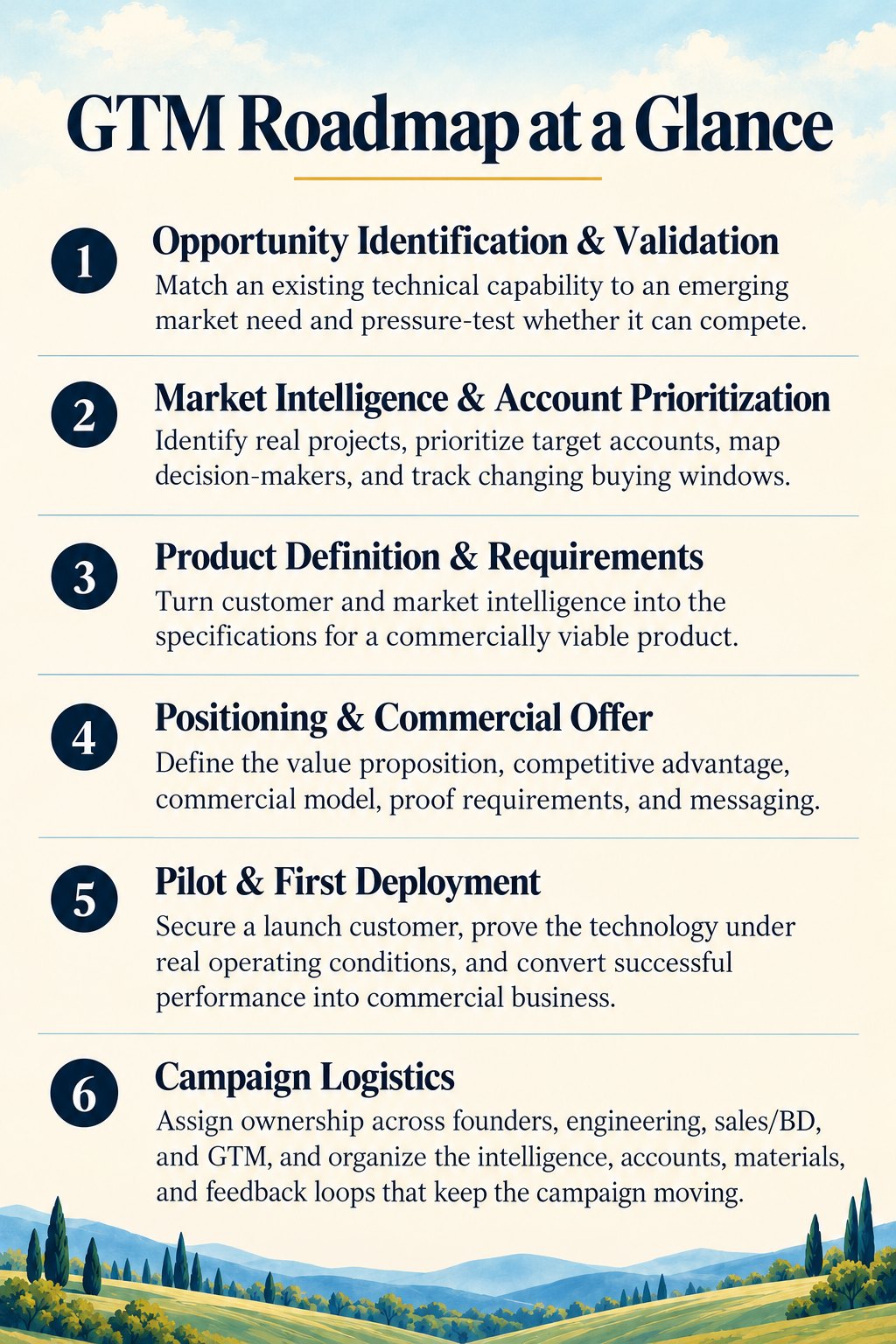
Text version of the infographic
- Opportunity Identification & Validation. Match an existing technical capability to an emerging market need and pressure-test whether it can compete.
- Market Intelligence & Account Prioritization. Identify real projects, prioritize target accounts, map decision-makers, and track changing buying windows.
- Product Definition & Requirements. Turn customer and market intelligence into the specifications for a commercially viable product.
- Positioning & Commercial Offer. Define the value proposition, competitive advantage, commercial model, proof requirements, and messaging.
- Pilot & First Deployment. Secure a launch customer, prove the technology under real operating conditions, and convert successful performance into commercial business.
- Campaign Logistics. Assign ownership across founders, engineering, sales/BD, and GTM, and organize the intelligence, accounts, materials, and feedback loops that keep the campaign moving.
I. Opportunity Identification & Validation
Identifying the Opportunity
Smart leaders keep an ever-watchful eye on the market for competitors, target audiences, and trends. Right now there is no bigger trend, irrespective of industry, than AI and data centers.
Successful startups are turning that market turbulence into opportunity by determining whether their technology can meet data-center energy demand.
Validating the Hypothesis
Test the hypothesis by:
1. Defining the requirements and assessing the capability fit. Establish the relevant benchmarks. In this case: megawatt capacity, 24/7 reliability, time to power, cost, scalability, footprint, fuel availability, permitting/emissions, and operating requirements. Compare those requirements against existing technology capabilities, identifying adaptations and associated costs.
This is obvious, but worth stating clearly: the opportunity only exists if the technology can meet requirements, beat out alternatives, and, of course, make money.
2. Leaning into credibility. Early market discovery, and therefore product viability, largely depends on people taking your calls. Credibility is the word of the day here. Your startup’s credibility may derive from the founders’ technical backgrounds, test results, respected investors or advisors, known partners, prior applications of the technology, or a warm introduction. Lean into this in your networking and marketing.
3. Pressure-testing against real projects and market timelines. Talk to investors, advisors, partners, developers, operators, utilities, and other industry contacts to learn what projects are in development, specific data-center power requirements, when infrastructure decisions will be made, what solutions are being considered, and where current options are falling short.
4. Finding the market-product timing match. Identify projects with requirements and development schedules that coincide with when your technology can realistically be ready for deployment. That is the critical intersection: right capability, right economics, right project, and right timing.
These steps don’t occur in a strict chronological order. Conversations with market insiders are ongoing to ensure that GTM strategy is continuously updated. Technical feasibility is also being evaluated throughout as what the market wants become defined. This is true at any point in a product’s lifecycle.
We’ve all seen companies led by product experts that focus too narrowly on product improvements without ongoing consideration of market trends influencing the product’s relationship with its target audience.
II. Market Intelligence & Account Prioritization
With the initial market survey and hypothesis validated at a high level, next is nailing down the best near-term opportunities.
1. Create a list of target accounts. Track data-center developments and all relevant data: owners and operators, locations, power requirements, project stage, current power strategy, and how closely those requirements align with the capabilities of the existing technology. Include any known constraints your technology could address.
2. Rate and prioritize accounts. Not all identified projects will offer the same viability as potential customers. Rate them based on technical fit, commercial potential, urgency, buying window, and the timing between their need and your product readiness. This concentrates resources on the accounts with the strongest probability of becoming real business.
3. Key in on the decision-makers. For each account, identify the players, honing in on who makes the decisions about powering the data center. It might be a team, but usually one person owns the power strategy, along with technical evaluators and other stakeholders who influence the decision.Seek out your network for people who can make introductions to these decision-makers.
Map those relationship paths alongside the account itself. Here you are essentially kicking off an account-based marketing (ABM) strategy.
4. Keep the intelligence current. Market and account intelligence is your GTM gold, but it’s only as good as it is current. Projects move, timelines slip, requirements change, and new alternatives enter the market. Update account intelligence continuously so GTM priorities reflect what is actually happening rather than serving as a great market snapshot from five months ago.
III. Product Definition & Requirements
Now is the exhilarating moment when the theory takes shape as a real product. Market intelligence informs the product definition and requirements for engineering to formalize the commercial version of the product. Engineering has been involved in evaluation; now the requirements become specific.
1. Capture customer requirements. Use discovery calls, technical meetings, RFPs, partner conversations, and project documentation to understand what priority accounts actually require: power output, reliability, deployment timeline, footprint, fuel, emissions, maintenance, integration, and cost.
2. Look for the common requirements. Compare those needs across accounts and identify the requirements that show up repeatedly rather than one-off customer requests.
3. Define the adaptation required. Compare requirements with existing technology capability: what can be reused and what requires modification or a full rebuild?
4. Set the first commercial configuration. Define the product specs that satisfy enough of the highest-priority accounts to be commercially viable and align with the buying window. The goal is to find the configuration with the strongest overlap between market demand, technical feasibility, and time to market.
5. Continue validating with customers. Keep prospects in the loop with product updates.
Potential customers are incentivized to help you create a product that solves their problem, so seek their technical feedback. It improves the product and will likely move them closer to a development agreement.
IV. Positioning & Commercial Offer
As the product specifications are finalized, product positioning development should follow. This phase is often glossed over to the startup’s detriment.
This work may seem to largely overlap with the market analysis in earlier steps, but it is not the same. It is a perspective shift. It’s seeing the product from the customer’s point of view. Simply slapping earlier market analysis into a positioning paper is doing your product a disservice. Instead, put yourself in the customer’s shoes, view the product from their position, and ask:
1. What is most valuable? Translate your technology into outcomes that matter to the customer. For a data center, it would likely be dependable MW capacity, 24/7 availability, faster time to power, competitive cost, scalability, and less dependence on delayed grid connections.
Here we are building the value proposition. This is the foundational piece for product positioning and the commercial offering. All of your marketing, and for that matter sales pitches, will flow from this.
2. Why is it better than the competition? Compare the solution against the alternatives. For data centers, this likely includes grid power, gas turbines, fuel cells, storage, or other onsite generation.
Specificity is key. Develop a comprehensive list of factors and rate your product against the alternatives. Data centers will be looking for wins on output, cost, deployment speed, footprint, fuel requirements, reliability, and emissions.
3. What is actually being bought? Define the commercial model, not just the technology. Is the customer buying generating equipment, a complete onsite power system, leased capacity, or power under a long-term agreement? Who owns and operates the system? Who handles maintenance and fuel supply? What partners are required to deliver it?
Once the commercial offering is clear, the market-facing name should reflect what the customer is actually buying rather than simply the engineering terminology used internally.
4. What is the proof? It’s one thing to tell a customer that you can do X, Y, and Z, but, to take an adage from storytelling: show them, don’t just tell them.
What proof would an engineer and business leader want to see? For a buyer taking a risk on a new power source, it’s probably engine or turbine test data, continuous-runtime results, delivered cost per MW, maintenance expectations, emissions/permitting viability, integration requirements, manufacturing capacity, and deployment timeline.
All of this information creates the basis for your marketing and messaging. Ideally, you have clearly recorded it and are storing it in a centralized location where anybody in the company can access it. This is what I call a Messaging and Positioning Manual.
Add detailed buyer-persona information and competitive analysis as you accumulate it. Use this manual as a guide for creating all public-facing and sales content, from website and nurture campaigns to technical briefs and capabilities decks.
It keeps the company on message and working in the same direction. Have one person accountable for updating it, but allow anyone to add notes so it is always current.
V. Pilot & First Deployment
You’re ready for takeoff! This is the transition into a real-world deployment where the technology can prove itself under commercially relevant conditions.
1. Secure a launch customer and structure the pilot. By now you will have worked your ABM campaign to the point of landing a customer willing to test the tech. Use your carrots. Create a win-win pilot or joint-development agreement covering scope, economics, responsibilities, performance targets, and what success unlocks commercially.
2. Track performance in real operating conditions. Test the tech against the agreed benchmarks. Track what matters most to the customer: output, uptime, integration, operating cost, maintenance, and reliability.
3. Turn pilot success into a commercial offer. Assuming the technology hits its performance and economic thresholds, restructure the agreement for longer-term commercial use. Package the results as performance data, economics, lessons learned, and customer validation to support the next set of accounts already moving through the pipeline.
If the pilot misses its thresholds, identify why and determine whether the gap is fixable or points to a deeper product-market problem. The company can then extend, modify, or stop the pilot, update the product and economics, and hold off on scaling until the issue is understood.
VI. Campaign Logistics at a Glance
1. Determine Who Owns What
Typical GTM responsibilities at a startup look something like this:
- Founders/executives: Strategic relationships, anchor customers, investors, major partners.
- Engineering: Technical feasibility, requirements, testing, and diligence.
- Sales/BD: Account pursuit, meetings, follow-up, opportunity progression, and commercial negotiations.
- Investors/advisors: Introductions, credibility, and market intelligence.
- Marketing/GTM: Synthesizes market intelligence, maintains the strategy, develops positioning and materials, and coordinates activity across teams.
2. How the Campaign Is Organized
The tech stack at each startup will look different, but should cover these core functions:
- CRM: Accounts, contacts, meetings, opportunity stage, ownership, and next steps.
- Living GTM workspace: Market intelligence, target-account priorities, product requirements, positioning, conversation insights, open questions, and strategic decisions.
- Reusable asset library: Approved messaging, technical proof, decks, briefs, FAQs, sales materials, and account-specific content.
- Feedback loop: New information from prospects, pilots, sales, and engineering continuously updates the strategy and materials.
This is the work I do. If you’re building a hard tech GTM campaign, I’d love to compare notes.