Field Notes · Credibility
Credibility Signals Make or Break Buying Decisions & They Are Hard to Measure - Here's What To Do
A highly technical audience will evaluate SaaS and hard tech B2B products like they're conducting a risk assessment. Their determination will rest mostly on technical evidence, but they will process other trust signals like who built the product and who is using it.
To the frustration of tech startups, much of this analysis occurs before a prospect reaches out, and largely escapes the visibility of marketing analytics.
You may never know precisely which signals influenced a purchasing decision, but you can be strategic about assembling and communicating them. Here we'll look at architecting a credibility stack, the cumulative effect of which will place your product and company in the high trust, low risk category for scrutinizing tech buyers.
But first, the science on trust formation...
The Science Behind Trust Formation
The Elaboration Likelihood Model (ELM) for persuasion was developed in 1986 by American social psychologists Richard E. Petty and John T. Cacioppo, and is considered a seminal work in explaining how people form attitudes. A person's mental processing of arguments in persuasive messaging falls on an "elaboration continuum" and takes two routes:
- Central Route: Involves high elaboration, deep critical thinking, and careful evaluation of the argument's quality and merits. It produces durable, long-lasting attitudes that strongly predict future behavior and reduce competitor poaching.
- Peripheral Route: Involves low elaboration, or less critical thinking, whereby people rely on more superficial cues, also called "heuristic" processing. It produces temporary attitude changes that are more vulnerable to counterargument.
You already know that the technical audience will take the central route in assessing your product’s capabilities, but don't sleep on the peripheral route. Those lower elaboration trust signals are important in creating first impressions and supporting central route trust building.
Architecting Your Credibility Stack
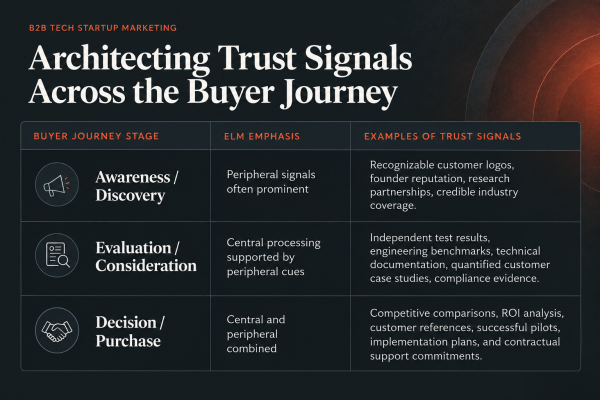
Here are effective credibility signals, their categorization in central or peripheral processing, and how to combine them to architect a credibility stack that follows your buyer's journey according to the classic three stages of a sales funnel.
1. Central Route (Deep Evaluation)
- Independent technical validation: Laboratory testing, benchmark studies, and documented performance results.
- Engineering proof: Qualification testing, reliability data, prototype demonstrations, and technical specifications.
- Customer proof: Pilot results, quantified case studies, and measurable deployment outcomes.
- Commercial validation: ROI models, before-and-after comparisons, and proxy metrics when ROI is unavailable.
- Compliance and security: Certifications, independent audits, and regulatory qualifications.
2. Peripheral Route (Credibility Cues)
- Recognized customers and partners: Customer logos, established industry partnerships, and research institution affiliations.
- Leadership credibility: Founder credentials, previous accomplishments, and recognized technical expertise.
- Third-party authority: Respected industry publications, independent laboratories, analyst recognition, and industry awards.
- Peer endorsements: Customer recommendations, professional referrals, and endorsements from trusted industry contacts.
Awareness Stage
In the awareness stage, peripheral signals are important in serving as the first credibility touch points. Buyers may be generating impressions of your company long before they assess the product.
- A recognizable customer logo can activate social credibility processing - I know that company, and they're well respected. If they're using this product, it might be worth a look.
- A respected industry leader behind the product can trigger a similar response - They've built some impressive technology before. This is probably worth considering.
- An established research institution or industry partner can lend credibility - If that organization is working with them, there must be something promising here.
- Coverage in a respected industry publication can prompt investigation - I've seen this company mentioned a few times. Maybe I should find out more.
These signals can earn something extremely valuable: the buyer's attention and desire to investigate.
Evaluation Stage
The evaluation stage is where the credibility heavy lifting happens. Your prospect already knows you and is taking a good hard look at everything under your product's hood.
Technical evaluators will want evidence that they can easily access and scrutinize, such as:
- Independent technical evaluations and benchmark studies: The performance looks impressive. Who conducted the tests, under what conditions, and can the results be replicated?
- Engineering proof and reliability data: They've demonstrated the core capabilities, but will this work under our operating conditions?
- Customer pilots and quantified case studies: It worked for that customer. Are their requirements comparable to ours, and what results could we reasonably expect?
- Compliance and security documentation: They've passed the relevant audits and certifications. That's one less risk we need to resolve.
Evidence needs to stand up to a technical audience’s examination, from how results were measured and validated to whether they can be repeated and where the claims stop. (Read more here)
Decision Stage
By the decision stage, the buyer is likely satisfied with your technology’s capabilities. The deal now rests on competing solutions, pricing, budget constraints, implementation timelines, and internal approvals.
Credibility shifts to addressing these remaining concerns and smoothing the path in moving forward with tactics like:
- Competitive comparisons and ROI analysis: How does this stack up against our other options, and can we justify the investment?
- A sandbox, prototype demo, free trial, or pilot with agreed success criteria: Let's see how this performs in our environment before we commit.
- Customer reference calls: I'd like to hear directly from someone who's already deployed it.
- Implementation timelines, system integration, and resource or deployment requirements: Can we deploy this within our budget, schedule, and operational constraints?
- Procurement and contractual readiness: Can they satisfy our purchasing requirements, security reviews, and contractual obligations?
- Documented onboarding and support commitments: Do they have the resources to get us operational and support us if something goes wrong?
Successfully moving through the decision stage is about giving buyers confidence that your solution is the right commercial choice, that implementation is feasible, and that your company can deliver on its commitments.
Trust Your Credibility Is Compounding, Even When You Can't Measure It
Your trust signals are making an impact, even if there is little evidence of it. Keep architecting your credibility stack to support the buyer's journey, and ensure its signals are accurate, consistent, and relevant to the risks buyers are weighing.
By the time a prospect reaches out, your credibility stack may have already done most of the convincing.