Field Notes · Strategy
Less Noise, More Signal: 6 Marketing Disciplines for B2B Tech Startups

There are many categories and terms for marketing niches these days. GEO, hyper-personalization, demand capture. A lot of it feels like noise, and it’s even confusing for marketers.
Only certain types of marketing are needed for a B2B tech startup. Cut the noise and expand your signal by learning about the six categories of marketing that connect your tech with the right buyers.
Same Starting and Ending Point, Different In-Between
To gain the trust of investors, partners, talent and buyers, you must prove your tech and that you possess the business acumen to bring your tech to market.
The first step for all marketing endeavors combines foundational product positioning, competitive analysis, and branding. As you initially determine your product and its audience, it is wise to simultaneously determine who you are as a company - values, vision, and mission - and how you communicate this cohesively in messaging and visual storytelling.
Branding shapes perspective. It doesn’t tell your audience that you are a smart business person; it shows them.
The other steps towards commercialization will depend on your tech, budget and market.
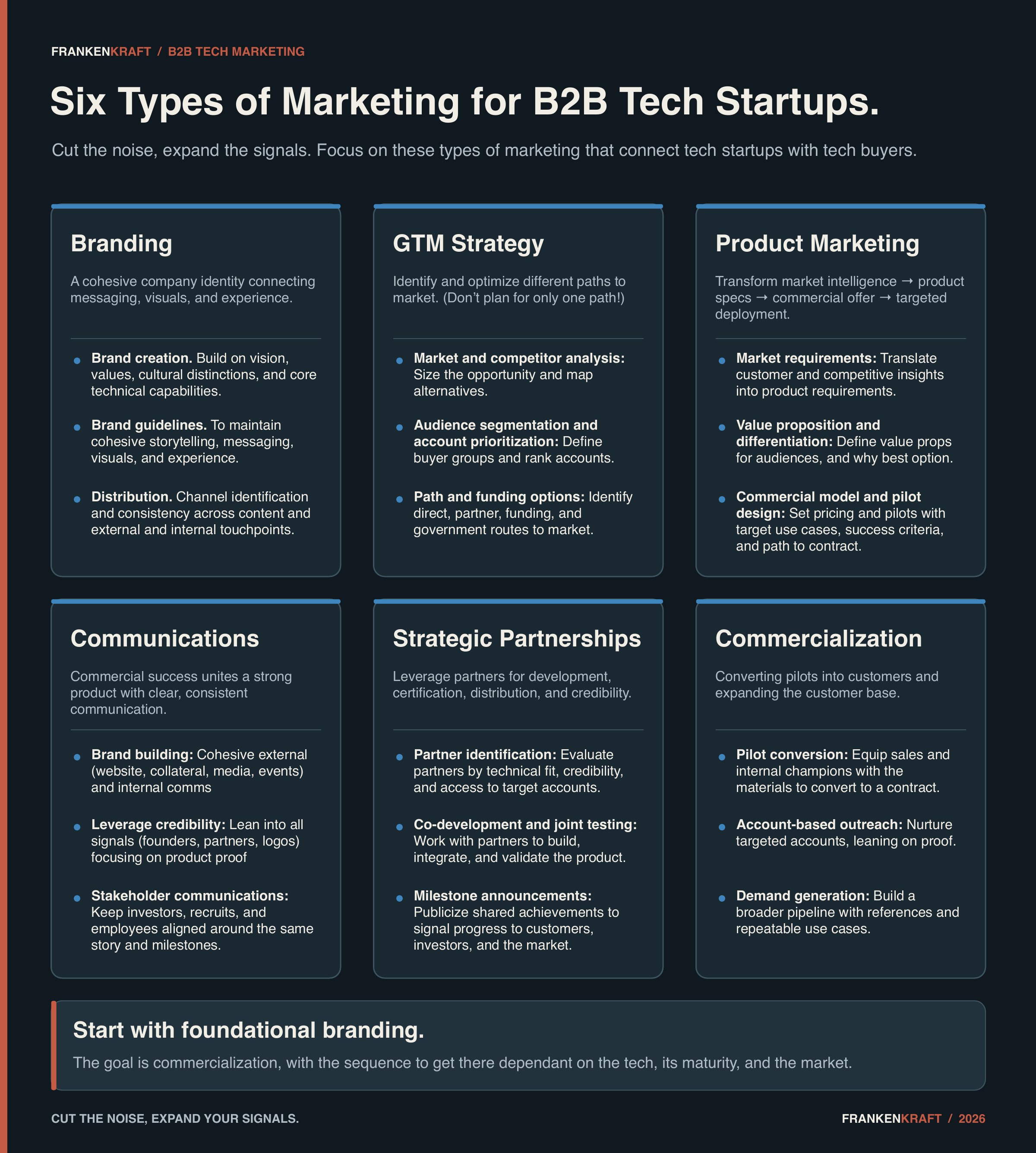
Text version of the graphic
- Branding. A cohesive company identity connecting messaging, visuals, and experience. Brand creation, brand guidelines, distribution.
- GTM Strategy. Identify and optimize different paths to market. (Don’t plan for only one path!) Market and competitor analysis, audience segmentation and account prioritization, path and funding options.
- Product Marketing. Transform market intelligence → product specs → commercial offer → targeted deployment. Market requirements, value proposition and differentiation, commercial model and pilot design.
- Communications. Commercial success unites a strong product with clear, consistent communication. Brand building, leverage credibility, stakeholder communications.
- Strategic Partnerships. Leverage partners for development, certification, distribution, and credibility. Partner identification, co-development and joint testing, milestone announcements.
- Commercialization. Converting pilots into customers and expanding the customer base. Pilot conversion, account-based outreach, demand generation.
Start with foundational branding. The goal is commercialization, with the sequence to get there dependant on the tech, its maturity, and the market.
What We Mean by B2B Tech Startup
Note that the graphic categorizes aspects of marketing relevant to tech B2B startups. This is inclusive of companies developing complex technologies for business, industrial, and government markets. It encompasses hard tech - like aerospace, defense, robotics, and energy - and enterprise SaaS.
While commercialization paths differ considerably, these industries share the challenge of translating technical capabilities into market value and winning over a technical audience.
Cutting out the noise and expanding your marketing signals rests largely on appreciating this definition of a B2B tech startup, and its distinction especially from B2C tech and B2B non-tech.
Selling tech products to tech businesses has a marketing path distinct from, say, a B2C company introducing a wearable device into a broad consumer audience. Such a startup would rely heavily on demand generation and ad budgets as it nears launch.
Similarly, a B2B non-technical company, like a food and beverage company selling into corporate supply chains, will lean into field events and ABM campaigns to expand their footprint.
A B2B tech startup will follow a different series of criss-crossing paths that feature different categories and responsibilities listed in the graphic. Learn more about GTM paths for B2B Tech.
The graphic is best understood as a key. It is not a sequencing chart or map. It is designed to help startups identify marketing needs based on maturation.
The categories and tasks will overlap and expand as a startup grows. Focusing on the tasks you need at the moment and near future, while planning for later work, makes your marketing initiatives, dollars and hires more impactful.
When to Expand Marketing
It’s natural for founders to initially take on marketing work, relying on investors and advisors for guidance. Consultants or freelancers are often tapped to fulfill certain tasks like assembling a visual brand.
Overall, marketing requirements will uptick in parallel with your technical progress, expanding and contracting in bursts as it rises over time. Eventually, the marketing duties expand beyond what the founders can manage. Then it might be time for a full-time marketing hire.
When considering hiring your first full-time marketer ask:
- What are you hiring for? Looking at the key, identify which objectives and tasks are most important. They will likely be concentrated around two or three marketing categories. This can help shape the role. For highly niche tech, like supersonic planes, a person with a comms and storytelling background will likely be a good fit since the company will need more branding and ABM management, rather than someone with more demand gen experience.
- What are the costs/benefits? Hiring someone full time is a known cost - the salary plus benefits. The existing costs can be harder to identify. For example, the time founders and other team members spend on marketing is an expense. Try to calculate and quantify that time. Coordinating a team of freelancers is another expenditure. But is their coordination and combined efforts optimally effective if they are led by someone who is not dedicated to marketing? There are costs associated with that lack of cohesion too.
- What perspective does an outside person bring? The right hire will not only have experience with specific responsibilities - maybe setting up HubSpot and lead scoring, or market research and content creation. But the best talent will bring more than that; they will bring a nuanced approach that levels up market impact. They will shape marketing strategy and execution to expand in areas needing more attention, emphasizing messaging that resonates, and removing resources from less-impact areas.
Maybe your cost/benefit analysis doesn’t quite fall on the side of hiring a full-time person yet, but you have plenty of marketing needs.
Consider the following resources if they aren’t already on your radar:
- Investors and advisors: Can provide strategic guidance, industry connections, and sometimes dedicated marketing expertise. However, their availability and ability to execute are limited.
- Project-based consultants and agencies: Provide specialized expertise for defined needs, such as positioning, branding, websites, or communications. The challenge is coordinating their efforts and maintaining consistency.
- Fractional marketing leaders: Bring senior-level strategy, oversight, and continuity without the cost of a full-time hire. However, they may still need specialists to execute certain initiatives.